

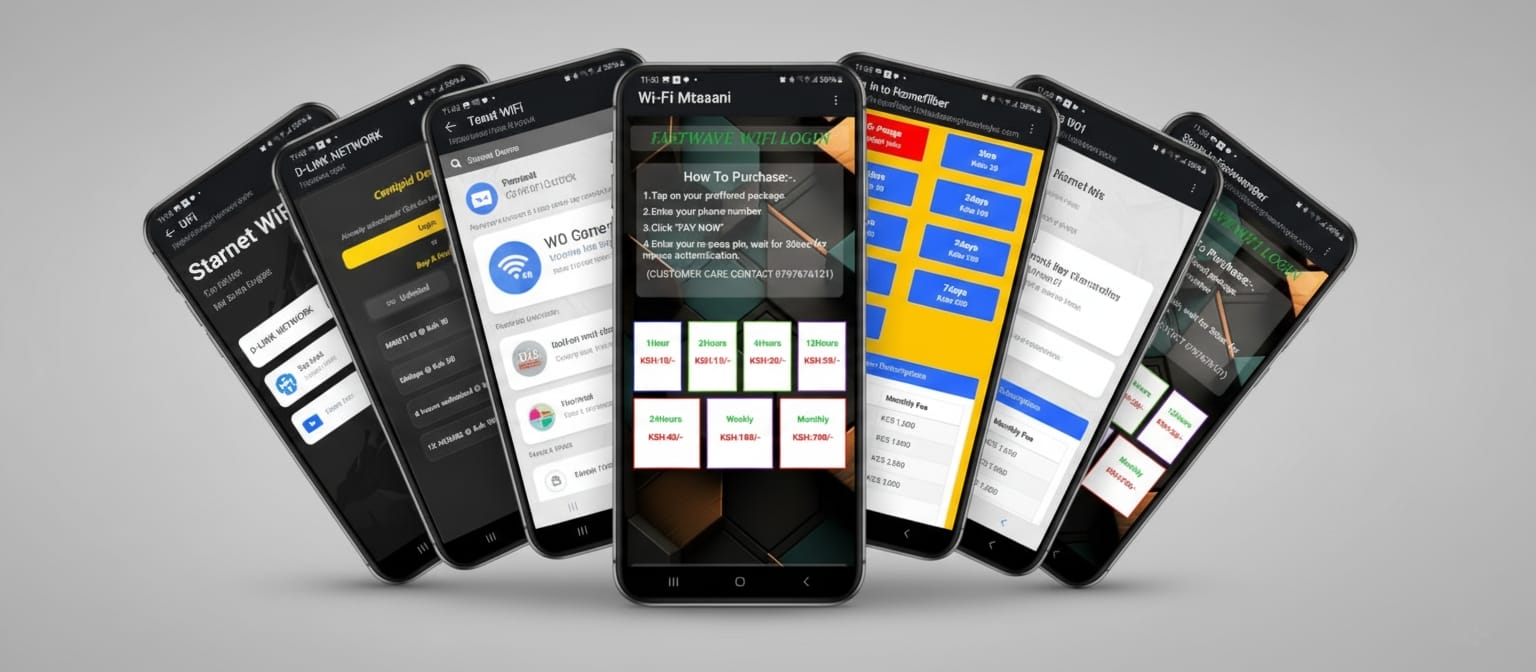

The number of people buying smartphones in Kenya is increasing every day. These smartphones has Wi-Fi.
More phones means more people ready to connect over wireless, which increases demand for hotspots and home WiFi. That is where Wireless Internet Service Providers (WISP) step in, and why you need a billing software to handle sign-ups, payments, suspensions, reconnections, and reports.
This page is a running list of Wi-Fi hotspot billing software providers available in Kenya. The list comes from our Google Form votes and the WiFi Mtaani WhatsApp group. Each entry has a short, neutral brief on the software and the company behind it. For deeper details, follow the link on each item to read the full review.
Voting for the best billing system is ongoing.
👉Cast your vote here: https://forms.gle/TeXCuziJagUfSxkw9.
Live polls also run in the WiFi Mtaani WhatsApp group: https://chat.whatsapp.com/EBcoJ7oXbmDCGPV5m8FvgC.
Monthly results are published here with cumulative figures, and current numbers are preliminary.
Centipid
Centipid is a Kenyan billing platform that supports both Hotspot and PPPoE.
It allows remote MikroTik management from the billing panel and integrates with M-Pesa and other local gateways for automated payments.
You can use a branded captive portal to sell vouchers, set speed plans, and manage client logins. The system also provides real-time reports on revenue, usage, and active clients.
New users get a 14-day trial, support is available on WhatsApp, and the company has offices at the I&M Bank Building, Upper Hill, Nairobi.
CloudTik
CloudTik is a cloud-hosted billing system built for Hotspot and PPPoE networks.
It is commonly used by small WISPs, estates, and cafés that need simple voucher management and automated account control. The platform integrates with M-Pesa for payments and can automate suspensions and reconnections.
It comes with a captive portal where operators can brand login pages, set speed limits, and define expiry times for vouchers.
Reporting tools show daily revenue, active clients, and bandwidth use. CloudTik runs fully online, so operators can manage networks from anywhere without setting up their own servers.
FreeISPRadius
I have seen FreeISPRadius used a lot by small WISPs and hotspot operators recently. It’s a lean, Radius-first billing tool that keeps things simple: captive portal or voucher access, session control, and basic reporting. I like it when I need something that just works without a heavy CRM layer.
What to check: M-Pesa or local payment hooks, SMS gateway options, and how easy it is to brand the portal. Also confirm backup and restore steps so you don’t lose user data.
ISPMan
ISPMan is a cloud-based WISP billing and network management platform that supports hotspot and PPPoE deployments. It provides user management, automated connect and disconnect workflows, and reporting for active clients and revenue.
Best for: Small to mid-size operators seeking an integrated panel for daily billing and routine router tasks.
Key features: MikroTik and Ruijee/Reeye router compatibility, M-Pesa payment options, SMS gateway support, API or webhook availability, backup and restore procedures, and SLA for uptime and support.
LipaNet (Lipanet)
LipaNet is a Kenya-focused billing platform for Hotspot and PPPoE networks, with built-in support for captive portals, voucher sales, and mobile money payments.
The product targets small and mid-size WISPs that need straightforward billing workflows and local payment handling.
Key Features: captive portal branding and templates, voucher and subscription plans, MikroTik integration, M-Pesa payment options, basic reporting for revenue and active clients. Exact M-Pesa flows supported, whether STK push, paybill and till are available, SMS gateway options, multi-site management limits, backup and restore procedures, SLAs for uptime and support, pricing model and hidden fees.
Splynx
Splynx is a full OSS/BSS platform offering billing, CRM, ticketing, inventory and network management, suitable for ISPs that plan to scale beyond simple voucher systems. It supports prepaid and postpaid models and integrates with a wide range of network and business tools.
Key Features: radius engine, billing and invoicing, ticketing and CRM, inventory and stock management, automation scripts, API and third-party integrations, on-premise or cloud deployment options.
What to verify before trial: availability of a local M-Pesa plugin or trusted third-party connector, recommended deployment mode for your scale, licensing and per-subscriber costs, training and migration services, local support or African distributor, performance limits for concurrent sessions.
PnP Radius (PnP-Radius)
PnP Radius is an enterprise RADIUS billing platform offering an all-in-one dashboard for AAA (authentication, authorization, accounting), usage tracking, captive portals and voucher sales.
Key features: session and event tracking, branded captive portal, voucher and self-service account pages, router integrations for automated connect/disconnect.
What to verify before trial: available M-Pesa payment methods and gateway partnerships, SMS gateway options, SLAs and local support channels, backup/restore and migration steps.
WifiPay (WifiPay / PrideTech)
WifiPay positions itself as an ISP billing and customer-portal platform for African ISPs, with automated billing, self-service portals, mobile money support and multi-tier plans.
Key features: recurring and one-time billing, mobile money integrations, customer self-service portal, multi-location support and APIs for integrations; published pricing tiers and a free trial are advertised on the vendor site.
What to verify before trial: confirm actual M-Pesa STK/paybill/till support and settlement times, trial limitations, true limits on user counts per plan, SMS gateway and WhatsApp notification support, and local support response times.
5Sok (FiveSok)
5Sok is an AI-powered hotspot management and billing system for African ISPs, offering real-time monitoring, custom bundles, and multi-payment support across many gateways.
Key Features.: captive portal and voucher sales, real-time analytics, multi-payment gateway support, and features marketed as AI-assisted optimisation for plans and usage.
What to verify before trial: exact M-Pesa options and settlement flow, limits on concurrent sessions and router count, SMS/WhatsApp notification options, data retention and backup policy, and local support response times.
BillNasi
BillNasi is an ISP billing system that advertises zero-touch package issuance, real-time hotspot monitoring, and support for PPPoE and voucher workflows. Pricing tiers and how features map to plans are shown on vendor pages.
Key Features: automated hotspot package creation, real-time user monitoring, payment gateway integrations (including demos showing MPESA and DPO setups), and admin dashboards for subscriber management.
What to verify before trial: supported M-Pesa modes (STK/paybill/till), settlement timing and fees, approved SMS gateways, concurrency limits, backup and restore processes, and local support or partner contacts.
Jossil
Jossil is a Kenya-marketed ISP billing system offering hotspot and PPPoE billing, unlimited MikroTik router support, M-Pesa integration, and tiered pricing for different subscriber counts.
Key capabilities: captive portal and voucher workflows, automated billing, real-time user monitoring, and packaged plans that list client limits and included features.
What to verify before trial: confirm exact M-Pesa modes supported (STK, paybill, till), active client limits per plan, SMS gateway options, backup and restore process, and local support response times.
SpeedRadius (SpeedComWiFi)
SpeedRadius, presented on SpeedComWiFi pages, positions itself as a Kenya-focused ISP billing system with automated billing, M-Pesa integration, unlimited MikroTik support, and real-time analytics. Vendor pages advertise a free trial and list local phone contacts.
Key features: voucher and member panels, automated connect/disconnect, dashboard analytics, API/automation hooks, and advertised 24/7 support lines.
What to verify before trial: validate the “unlimited router” claim against concurrent session limits, confirm M-Pesa settlement and supported flows, check trial feature limits, and request customer references or case studies from Kenyan deployments.
Wispman
Wispman is an ISP management and billing system for PPPoE and hotspot operators, offering automated payments, client tracking, and real-time monitoring.
Key features: automated connect/disconnect workflows, captive portal and voucher support, dashboard analytics, and admin controls for subscriber management.
Supported M-Pesa modes and settlement terms, SMS/WhatsApp notification options, true limits on concurrent sessions and router count, backup/restore process, and local support channels or SLA.
XceedNet
XceedNet is a 100% cloud-hosted ISP billing and bandwidth management platform (Amazon AWS) that supports hotspots and MikroTik integrations, vouchers, automated billing, and subscription management. It is marketed for ISPs and hotspot operators in Kenya and other markets.
Key features: real-time bandwidth control and reporting, prepaid/postpaid billing, voucher and invoicing automation, subscriber lifecycle management, and API/third-party integrations.
What to verify before trial: exact M-Pesa or local payment plugins supported and settlement timing, trial feature limits, recommended MikroTik configuration, data residency (if required), and regional support contacts or distributor details.
SmartISP
SmartISP is an all-in-one ISP billing and management suite offering RADIUS billing, CRM, and subscriber portals for hotspot and PPPoE networks. The product is presented as a turnkey system for small and medium ISPs with demo and login pages available online.
Key capabilities: subscriber management, hotspot and PPPoE billing, reporting and analytics, and remote router/NAS integrations. SmartISP
What to verify before trial: supported M-Pesa modes (STK, paybill, till) and settlement times, SMS/WhatsApp notification options, concurrent session and router limits, backup/restore procedures, and local support contacts or SLA.
Netpap (Netpap Global)
Netpap is a cloud-based ISP billing and hotspot management platform marketed as a carrier-grade solution for ISPs, with features for bandwidth control, billing, KYC, and notifications. The vendor targets Kenyan ISPs and advertises cloud deployment and API integrations.
Key capabilities: cloud billing, hotspot management, subscriber lifecycle tools, notification engines, and third-party integration options.
What to verify before trial: exact M-Pesa and payment processor integrations, recommended deployment for expected subscriber load, data retention and privacy terms, API availability and docs, and regional support contacts.
Bosmi
Bosmi appears in community lists as a local ISP billing option, but public feature details are thin and vary by source. Operators report voucher workflows and basic hotspot management, though specifics on payment integrations and limits are unclear.
Key capabilities to verify: exact M-Pesa support (STK, paybill, till), captive portal branding, concurrent session and router limits, SMS/WhatsApp notification options, backup/restore procedures, and local support contacts or SLA.
Other community submissions
Several small or bespoke billing tools circulate in the WiFi Mtaani group and the Google form responses. These may be local one-off systems, reseller packages, or young startups that lack public docs.
What to do: If a vendor is missing from this list, submit it via the voting form (https://forms.gle/TeXCuziJagUfSxkw9) or share the vendor URL/contact in the WiFi Mtaani WhatsApp group (https://chat.whatsapp.com/EBcoJ7oXbmDCGPV5m8FvgC). For each addition, confirm payment flows, router compatibility, and support channels before trial.
How to Choose the Best Hotspot Billing Software in Kenya
Use this checklist to compare vendors quickly. For each item, confirm it on the vendor demo or trial.
Router and protocol support, compatibility
Confirm support for the exact router models and firmware in use, for example MikroTik, Ubiquiti, or custom NAS. Check PPPoE, hotspot, VLANs, and simultaneous session limits.
Payments and settlement
Verify M-Pesa modes supported, STK push, Paybill, Till, settlement timing, and fees. Confirm other local gateways and whether the vendor handles reconciliation or leaves it to the operator.
Customer experience
Test the captive portal speed on mobile devices, ease of signup, voucher flows, and self-service options. Language, branding, and portal responsiveness matter for repeat sales.
Automation and lifecycle rules
Check expiry rules, grace periods, auto suspend and reconnect flows, and scheduled tasks. Good automation reduces manual ops and billing errors.
Notifications and communications
Confirm SMS gateway and WhatsApp or email notification support, template controls, and cost per message. Notifications help reduce payment friction and churn.
Reporting and exports
Require daily cash reports, subscriber lists, churn and usage reports, and CSV/Excel exports. Ensure the system provides the reports needed for accounting and tax purposes.
Integrations and APIs
Confirm API, webhook, or third-party connector availability for CRM, accounting, SMS, and custom apps. API access speeds automation and future integrations.
Reliability and backups
Ask about uptime targets, backup frequency, geo redundancy if cloud hosted, and recovery procedures. Request SLA or written uptime figures for critical deployments.
Security and compliance
Check roles and permissions, audit logs, password policies, and data retention. Ensure the vendor is clear about where customer data is stored and who can access it.
Pricing model and total cost
Compare per-subscriber, per-router, or flat pricing, plus transaction and SMS costs. Watch for setup, migration, and hidden fees that change the true cost of ownership.
Support and local presence
Prefer vendors with local contacts, fast response times, training, and deployment help. Local support shortens downtime and eases M-Pesa integration issues.
Priorities by operator size
- Small hotspot operator: prioritize captive portal UX, voucher flow, M-Pesa STK, low cost, simple setup.
- Small to mid WISP: emphasize router compatibility, automation, reporting, and reliable local support.
- Growing or large ISP: require robust OSS/BSS, APIs, ticketing, inventory, migration services, and clear SLAs.
Vote now to shape the community rankings, https://forms.gle/TeXCuziJagUfSxkw9. Live discussion and quick checks happen in the WiFi Mtaani group, https://chat.whatsapp.com/EBcoJ7oXbmDCGPV5m8FvgC
Final Thought
Match a billing system to your network needs, not to hype.
For small hotspots, prioritise captive portal UX, voucher flows, and M-Pesa STK. For growing WISPs, pick solutions with solid router support, automation, APIs, and reliable local support.
For larger ISPs, require OSS/BSS features, ticketing, inventory, and clear SLAs.
A simple rollout plan works well: shortlist three vendors, run each in a two-week live trial, test M-Pesa payments end-to-end, simulate suspensions and reconnections, and export reports for your accountant.
Record issues, then pick the best fit and share your results so the community benefits.


Leave a Comment